
Quick Summary
Portable escape games are self-contained puzzle experiences that travel to festivals instead of requiring guests to visit a fixed room. To choose one, measure your site including the queue zone, confirm setup time and power needs, and plan capacity around round length and crowd flow.
- Measure the footprint, including queue space: a 10-by-10-foot game with a 20-foot queue needs 10 by 30 feet.
- Confirm setup and strike time, since every minute of teardown is a minute the booth earns nothing.
- Get the power draw in watts or amps and site any generator away from the play area.
- Work out capacity: players per round times stations times rounds per hour.
- Round length is the detail that most often goes wrong; a long round backs up the line before lunch.
Table of Contents
- What Portable Escape Games Are and How They Work at Festivals
- Portable Escape Room Rental vs. Buying a Portable Escape Room Box
- Space, Setup Time, and Power Needs on a Festival Site
- Planning Capacity, Crowd Flow, and Session Length
- Budgeting, Permits, and Safety for Festival Game Setups
- Running a DIY Portable Escape Game Yourself
- Booking Your Festival Escape Game With United Escapes of America
- Frequently Asked Questions
What Portable Escape Games Are and How They Work at Festivals
Last Updated: November 14, 2026
Portable escape games are self-contained puzzle experiences that travel to the event rather than asking guests to come to a fixed room. Providers describe them as easy to transport and quick to set up, which is why festival organizers, fairs and event agencies are looking at them.
The basic model works like this: a provider ships or delivers a ready-made game, a staff member or trained host runs the session, and guests work through clues in a short, contained round.
Festivals are a common pay-and-play setting for this format. Carnivals, fairs, festivals and pumpkin patches are all listed by event sources as places where portable games can draw walk-up players, so the game has to be understandable within seconds of sitting down.
Watch out: round length is the detail that most often goes wrong. A game that runs longer than the slot you planned will back up the line before lunch.
Portable Escape Room Rental vs. Buying a Portable Escape Room Box
Renting and buying solve different problems. A rental puts a provider’s staff, props and setup in front of your guests for a set event, and you pay for that event. A purchased escape room box stays with you, so you can run it at any event, but you take on setup, staffing and wear.
Pricing depends on quantity, dates and delivery, so request a quote from United Escapes of America and check the company website for current options.
Space, Setup Time, and Power Needs on a Festival Site
Before you commit to any format, measure the space and match it to the site, not just to the game. Add the queue zone to that footprint: a 10-by-10-foot game with a 20-foot queue line needs 10 by 30 feet of usable ground, and festival organizers allocate space by the foot.
Ground conditions matter as much as dimensions. Grass, gravel, asphalt and temporary flooring all change how a game sits and how guests move through it. Ask whether the game needs level ground, whether it can be staked or must be weighted, and whether the provider supplies weights or ballast. On asphalt, stakes are not an option, so a frame that relies on them will not hold. On grass, rain turns a queue line into mud, so plan a mat or a raised walkway at the entrance.
Setup time matters more at a festival than in a fixed venue, because every minute of teardown is a minute the booth earns nothing. Ask the provider how long the game takes to set up and strike, and whether it needs a table, chairs, a power outlet or lighting. Get the power draw in watts or amps, not just “low power,” and confirm whether the festival supplies power to your booth or whether you need a generator. A generator near a puzzle game adds noise that can make audio clues unusable, so site it away from the play area.
Plan for the weather. Props, paper clues and electronics all suffer in wind, rain and direct sun, so ask how the game is packed and whether a covered area is needed. A tent with sidewalls protects paper and electronics but can turn into a sauna in direct sun, so check ventilation. Wind is the bigger risk for lightweight props: ask what the provider does to keep loose pieces from blowing across the site.
Accessibility belongs in the site plan, not in a footnote. Check that the route from the main path to the game entrance is firm, level and wide enough for a wheelchair or a stroller, and that the game itself can be played by someone who cannot stand for a full round. Festival organizers increasingly ask for this information, and a game that cannot accommodate a range of abilities will limit who can play.
Run a pre-event site check. Walk the space at the same time of day as your session, confirm where power and water are, note the nearest emergency exit and fire lane, and measure the distance to the nearest restroom and concession stand, since those drive foot traffic past your booth. Confirm with the organizer whether your booth can play amplified audio and what the site’s noise rules are during performances.
Watch out: a game that fits the footprint but blocks a fire lane or an accessible route can be shut down on the day, so clear the layout with festival operations before you load in.
Planning Capacity, Crowd Flow, and Session Length
Capacity is the number that decides whether a portable game pays off at a festival, and it is where most supplier pages stay vague. Work it out before you book: players per hour equals players per round multiplied by the number of simultaneous stations, then multiplied by the number of rounds you can run in an hour.
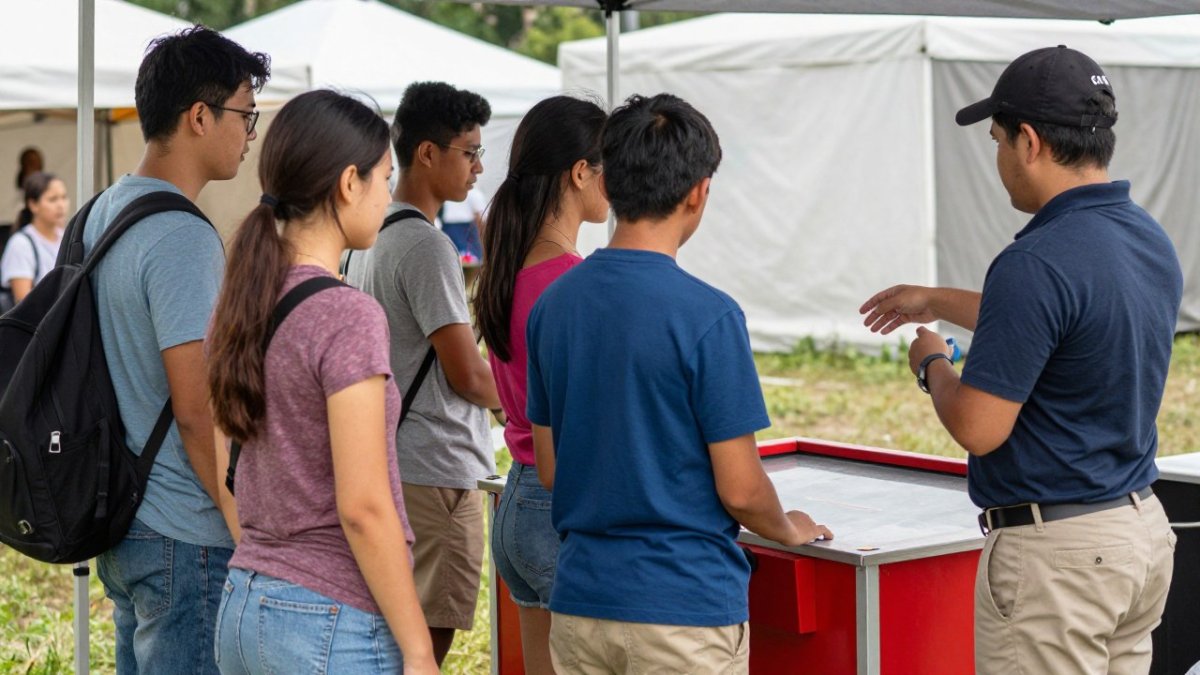
If you need to serve a crowd of 200 over a four-hour window, you need roughly 50 players per hour, which usually means three or four simultaneous stations rather than one larger game.
Timed sessions flatten the queue, let you fill a round with a mixed group when demand is light, and give waiting guests a clear return time so they spend money elsewhere on the site instead of standing in line. A common pattern is to hold two slots per hour open for walk-ups and pre-book the rest through a sign-up sheet at the booth.
Crowd flow is the other half. A queue needs space to form without blocking foot traffic, so place the game where people already gather but keep the entry and exit paths separate. Finished groups should exit away from the line, not through it. Use a stanchion, a rope line or a painted footprint on the ground to define the queue, and put a visible sign at the entrance showing round length and group size so guests self-select before they commit. If your booth sits on a main thoroughfare, angle the game so the back of the queue runs parallel to the path rather than across it.
Session length also affects who will play. Younger children and casual walk-ups tend to prefer shorter rounds of 10 to 15 minutes, while enthusiasts may want a longer, harder puzzle. Decide your audience first, then pick the round length that fits. Group size is worth confirming in writing: ask whether the game is built for small teams or can handle a larger group, since a game sized for six will struggle with twelve, and a game sized for twelve often feels empty with four.
Watch out: a game that runs longer than the slot you planned will back up the line before lunch, and a queue that blocks an aisle can get your booth moved by festival operations.
The table below sums up the session and capacity figures from this section so you can compare round lengths and crowd-handling choices at a glance.
| Item | Value | Note |
|---|---|---|
| Target crowd example | 200 over four hours | About 50 players per hour |
| Stations needed for example | Three or four | Simultaneous stations rather than one large game |
| Casual or younger players | 10 to 15 minutes | Shorter rounds suit walk-ups |
| Walk-up slots | Two per hour | Held open alongside pre-booked sign-ups |
| Queue space example | 10 by 30 feet | 10 by 10 game plus 20-foot queue line |
| Biggest risk | Round runs past slot | Backs up the line before lunch |
Budgeting, Permits, and Safety for Festival Game Setups
Permits and insurance vary by location and event. Check with the festival organizer what permits, insurance certificates and site rules apply to your booth, and confirm the requirements with local authorities before the event. Do not assume that a provider’s paperwork covers your site.
Safety planning covers more than physical hazards. Keep a basic contingency plan written down, including a point person and a way to pause the game.
Running a DIY Portable Escape Game Yourself
Prepare a short briefing you can give in under a minute, covering the story, the rules and the time limit. Keep spare clues and props packed, and label each one so a volunteer can reset the game quickly between rounds.
Assign roles before the rush. One person runs the entry and timing, one watches the game, and one manages the queue. A DIY setup with clear roles usually runs more smoothly than one where a single person tries to do everything.
Booking Your Festival Escape Game With United Escapes of America
If you want a game built around a festival crowd, start by checking what we currently offer. Our Mesa CycloMesa Unchained scavenger hunt shows the kind of festival-style event we run, so you can see how a family or group might take part.
For private festival requests, reach out through our contact page. Tell us your event dates, expected headcount and session length, and we will help you work out a plan. If you are thinking about a longer relationship, our franchise opportunities page explains how partners get involved.
Pricing for private events depends on the format, dates and delivery, so we will provide a quote rather than a fixed number. For a realistic view of what costs add up to, read our price breakdown of escape rooms before you talk to us.
Frequently Asked Questions
What is a portable escape game?
A portable escape game is a self-contained puzzle experience that can be set up outside a permanent escape room facility, often at festivals, fairs, corporate events, or private parties. Players work in a small team to solve clues, open locks, and finish a themed mission within a set time limit. Some versions arrive as ready-made kits with props and instructions, while others are delivered and run by staff. Because the game does not depend on a fixed building, the main planning questions are about space, power, setup time, and how many guests can rotate through in a day.
Can you rent a portable escape room for an event?
Many providers rent portable escape games for single-day events, and pricing depends on quantity, dates, and delivery distance. For current availability and a quote, visit the United Escapes of America website or request a quote directly.
How much space does a portable escape game need?
Space needs vary by format, so confirm the exact dimensions with the provider. Plan for extra room for guests to queue, for a staff member to supervise, and for a clear exit path. Festival sites often have uneven ground, tents, and shared walkways, so check whether the game needs a level surface, shade, or weather protection. Measure your allotted space before you finalize the booking.
How long should a festival escape game take?
Build in buffer time during peak hours so lines do not stall and players do not wait too long between rounds.
